Estimated Reading Time: 8 minutes | Last Updated: September 2026
AI API Cost Calculator: Estimate LLM Token Expenses Instantly
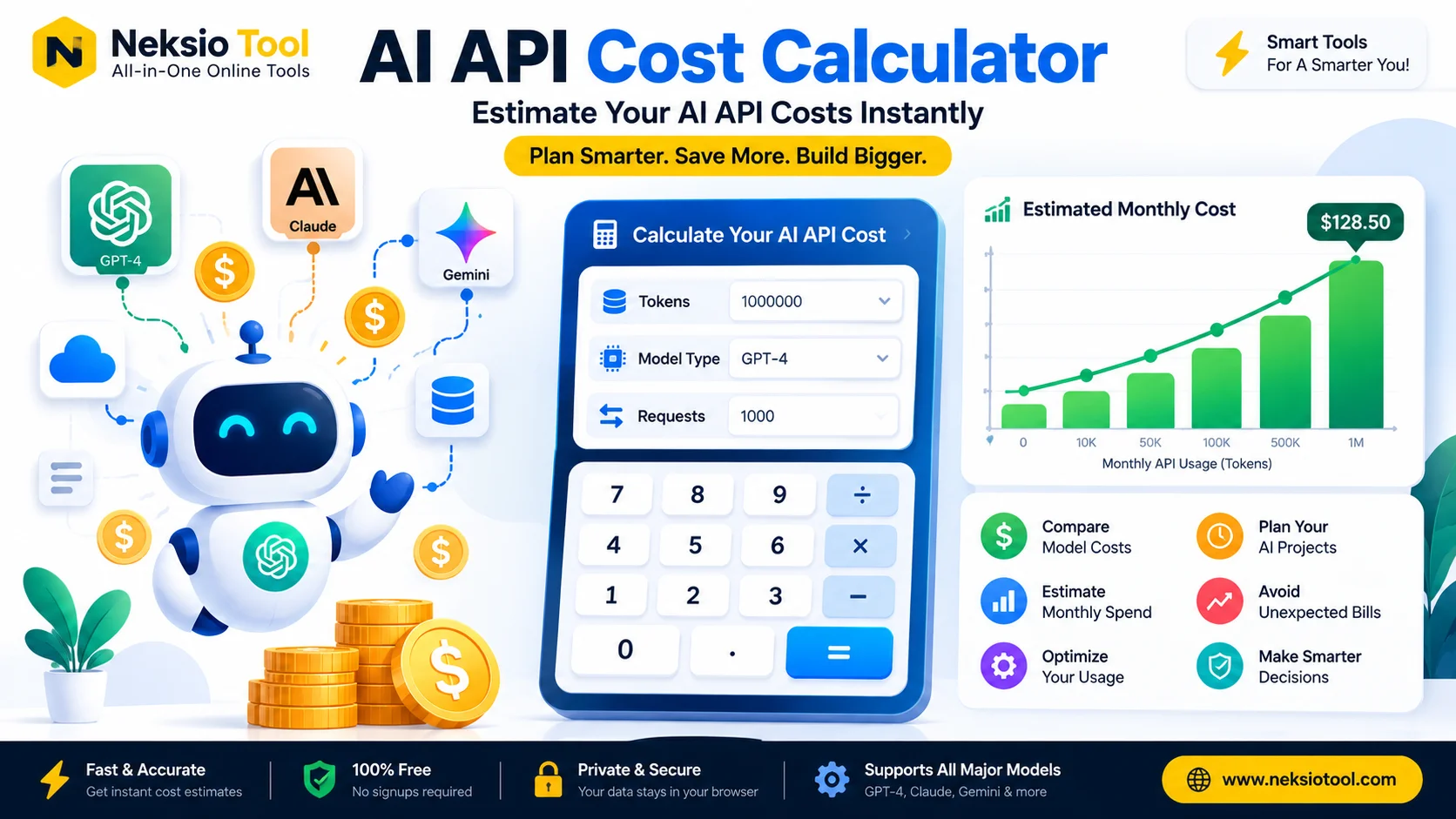
Deploying production applications powered by large language models shouldn’t mean gambling with your monthly cloud budget. Whether developing an automated customer support bot, scaling an enterprise RAG pipeline, or testing autonomous agent workflows, forecasting your AI API costs is essential for positive unit economics. Our free online AI API Cost Calculator provides real-time, precision-grade expense projections across OpenAI, Anthropic, Google Gemini, and custom LLM endpoints directly in your browser.
This developer-first utility eliminates unexpected billing spikes. It requires no sign-ups, no software downloads, and guarantees 100% privacy because all calculations happen locally on your device without sending any data over external servers.
📌 Quick Summary
- Broad Model Coverage: Pre-configured for GPT-4o, Claude 3.5, Gemini 1.5, Mistral, and manual rates
- Asymmetric Token Calculation: Precise blended costing separating prompt (input) and completion (output) rates
- Complete Privacy: Zero data collection—everything runs strictly client-side inside your browser
- Frictionless Access: 100% free with unlimited calculations and no account creation required
📑 Table of Contents
- Why AI API Cost Calculation Matters
- How the AI API Cost Calculator Works
- Understanding LLM Pricing Models
- Cost Optimization Strategies
- Step-by-Step Usage Guide
- Real-World Cost Scenarios
- Enterprise & Production Considerations
- Benefits of Our Free Calculator
- Frequently Asked Questions
- Key Takeaways
- Final Thoughts
Why AI API Cost Calculation Matters
Modern LLM billing has shifted from basic flat-rate subscriptions to nuanced token metrics that fluctuate based on model depth, context size, caching capabilities, and prompt-to-completion ratios. Without clear forecasting, scaling your application can trigger sudden budget drains or stall ongoing product development.
Key drivers of LLM billing variance include:
- Token Asymmetry: Output tokens are resource-intensive for GPUs to generate and generally cost 3x to 4x more than input tokens.
- Architecture Tiers: Lightweight models (like GPT-4o Mini or Gemini Flash) offer high throughput at a fraction of frontier model prices.
- Large Context Windows: Submitting massive contexts (upwards of 100K tokens) without active caching causes expenses to multiply quickly.
- Volume Commitments: Reserved capacity and enterprise contracts modify baseline per-token pricing structures significantly.
Using an accurate AI API Cost Calculator replaces complex manual spreadsheets with dependable forecasting before deployment. To verify the latest official rate changes directly from foundation providers, consult the OpenAI API Pricing Page or your chosen vendor’s documentation.
How the AI API Cost Calculator Works
The calculator applies industry-standard token accounting formulas adapted to modern per-million-token (1M token) pricing models:
Core Formula
Total Monthly Cost = ((Prompt Tokens × Input Rate) + (Completion Tokens × Output Rate)) × Monthly API Requests
Key Inputs Required
- Target Model: Select from preset models or enter custom per-million token pricing.
- Request Frequency: Expected number of requests per day, week, or billing cycle.
- Average Input Length: Estimated number of prompt tokens (including system instructions and RAG snippets).
- Average Output Length: Anticipated completion tokens generated per reply.
- Currency Selection: View your projected totals in your preferred financial currency.
Dynamic Architectural Adjustments
The calculator lets you account for cost reductions from prompt caching and batch inference workflows. If you are structuring complex routing workflows across multiple models, organizing your architectural tiers with our List Sorter helps order model priority based on cost-per-query benchmarks.
Understanding LLM Pricing Models
Different providers implement distinct billing rules and rate structures. Comparing these side-by-side ensures accurate budgetary planning:
| Provider & Family | Standard Pricing Unit | Notable Billing Advantage |
|---|---|---|
| OpenAI (GPT-4o, Mini) | Per 1M tokens | Automatic prompt caching discounts and 50% batch API reductions |
| Anthropic (Claude 3.5 Sonnet, Haiku) | Per 1M tokens | Up to 90% savings on prompt caching for repeated context blocks |
| Google Gemini (1.5 Pro, Flash) | Per 1M tokens | Generous free tiers for testing and low per-token inference rates |
| Mistral AI | Per 1M tokens | High-efficiency commercial models and sovereign European cloud hosting |
| Azure OpenAI Service | Per 1K / 1M tokens | Enterprise compliance frameworks and regional quota allocations |
Cost Optimization Strategies
Calculating your baseline expenditure is only the first step. Engineering teams can apply several concrete tactics to actively curb their monthly LLM spend:
1. Prompt Engineering and Pruning
Cutting unneeded preamble and whitespace from system prompts can trim input token volumes by 20% to 30%. Minimize context size by returning only targeted excerpts from your vector database.
2. Intelligent Model Cascades (Routing)
Route simple tasks (classification, simple extraction) to cost-effective models like GPT-4o Mini or Claude 3.5 Haiku, reserving flagship models solely for multi-step reasoning. This hybrid routing strategy often lowers blended inference costs by 40% to 60%.
3. Hard Output Constraints
Enforce strict max_tokens limits in your API payload. Unchecked generative responses consume expensive output tokens without adding proportional user value.
4. Caching and Batch Queuing
Take full advantage of persistent context caching. For deep implementation details, study the Anthropic Prompt Caching Guide to understand how caching long system prompts cuts input expenses by up to 90%. When analyzing token payloads across network layers, you can also utilize our Byte Converter to align character counts with expected payload bandwidth.
Step-by-Step Usage Guide
Estimating your LLM deployment budget takes only four simple steps:
1. Choose Your LLM Provider
Pick a provider from the preset dropdown menu (OpenAI, Anthropic, Google, Mistral) or select “Custom” to enter proprietary model numbers.
2. Input Your Traffic Projections
Enter your anticipated monthly request count, along with the average prompt size and completion size based on your development test logs.
3. Factor in Discounts
Apply any available prompt caching percentages, batch processing rates, or contracted volume tier adjustments.
4. Review Your Expenditure Breakdown
Inspect the generated report showing total monthly burn, average cost per individual query, and the precise cost distribution between input and output tokens.
Real-World Cost Scenarios
Scenario 1: High-Volume Customer Service Chatbot
Monthly Volume: 60,000 conversations
Average Tokens: 900 input | 250 output
Selected Model: GPT-4o Mini
Projected Cost: ~$35 – $50 / month
Scenario 2: Dense Document Extraction & RAG Pipeline
Monthly Volume: 5,000 PDF documents
Average Tokens: 18,000 input | 1,200 output
Selected Model: Claude 3.5 Sonnet
Projected Cost: ~$280 – $340 / month (without caching)
Scenario 3: Automated Code Review Agent
Monthly Volume: 25,000 code pull requests
Average Tokens: 4,000 input | 800 output
Selected Model: Gemini 1.5 Flash
Projected Cost: ~$18 – $28 / month
When tracking how your operational costs evolve across release milestones, our Date Difference Calculator makes it easy to measure cost variations over specific product deployment schedules.
Enterprise & Production Considerations
Moving from prototype to production introduces operational factors that go beyond base pricing:
Rate Quotas and Concurrency
Exceeding Tier rate limits (TPM / RPM) triggers costly fallback models or failed requests. Always budget for buffer overhead and integrate intelligent retry-backoff logic.
Data Privacy and Compliance
Enterprise deployments frequently require Zero Data Retention (ZDR) or specific regional hosting zones (e.g., EU-only instances), which may have dedicated pricing schedules.
Real-Time Budget Guardrails
Set automated spend alerts at 50%, 75%, and 90% of your maximum spending threshold inside your provider dashboard to prevent unexpected traffic spikes from exhausting credits.
To safeguard your documentation and keep automated web scrapers from hitting your endpoints, check our Robots.txt Generator to maintain proper crawler directives for your technical web properties.
Benefits of Our Free AI API Cost Calculator
- Immediate Cost Projections: Instant results without setting up manual spreadsheet formulas
- Multi-Model Comparison: Evaluate performance vs cost tradeoffs across different vendors
- Guaranteed Data Privacy: Complete client-side calculation ensures your project metrics remain private
- Responsive & Mobile Friendly: Runs smoothly in any browser on desktop, tablet, or smartphone
- Unrestricted Utility: Free to use as often as needed with zero subscription barriers
- Up-to-Date Figures: Regularly updated to match newly announced provider token pricing
Frequently Asked Questions
Yes, our AI API Cost Calculator is 100% free with no hidden charges, tiered subscriptions, or daily limits. All calculations run client-side inside your web browser.
It supports leading LLM providers including OpenAI (GPT-4o, GPT-4o Mini), Anthropic (Claude 3.5 Sonnet, Claude 3 Opus), Google Gemini (1.5 Pro, 1.5 Flash), Mistral, and custom API endpoints with manual rate inputs.
Projections are mathematically exact based on standard per-1M token rates published by providers. Minor variances may arise from dynamic context caching, regional taxes, or specialized enterprise SLAs.
Yes. Output (completion) tokens typically cost 3 to 4 times more than input (prompt) tokens. Our tool calculates both rates separately to deliver an accurate blended cost estimate.
Yes. You can add multiple rows to compare cost differences across different model families or evaluate hybrid architectures before deploying to production.
Yes. You can account for volume-based enterprise commitments and prompt-caching deductions to reflect customized contractual rates.
No. All computations occur entirely on the client side inside your web browser. No token counts, volume metrics, or custom figures are ever sent to our servers.
Key Takeaways
- Accurate AI API cost estimation protects development budgets and secures healthy unit economics.
- Accounting for token asymmetry is essential, as output tokens cost significantly more than input tokens.
- Hybrid model routing can trim inference expenditure by up to 60% without compromising response quality.
- Prompt caching and batching provide massive cost savings for large-context and non-real-time operations.
- Client-side tools protect confidential project statistics while calculating infrastructure budgets.
Final Thoughts
Forecasting your LLM deployment costs doesn’t have to be a guessing game. Armed with the right calculations and cost-saving techniques, you can confidently scale your AI features while keeping infrastructure expenses completely predictable.
Our free AI API Cost Calculator provides instant transparency into your projected spend without compromises. Calculate your requirements, compare architectural tradeoffs, and optimize your LLM expenses with zero friction.
Ready to project your API spending? Use our AI API Cost Calculator right now for fast, private, and precise figures.
💰 Estimate your AI API costs in seconds! Free, private, and instant LLM expense projections. No signup required.
Calculate My AI API Costs Now →