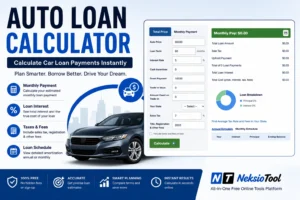

Purchasing a recreational vehicle is an exciting milestone that opens the door to adventure and open-road freedom, but navigating recreational vehicle financing requires clear math. An accurate rv loan calculator is the essential financial instrument prospective buyers and experienced campers depend on to forecast monthly payments, analyze interest rate fluctuations, and evaluate overall loan amortization before signing a dealership contract.
Unlike traditional passenger car loans that span 36 to 72 months, RV financing often extends anywhere from 10 to 20 years for luxury motorhomes and fifth wheels. Even a modest 1% difference in your Annual Percentage Rate (APR) can cost or save you tens of thousands of dollars over the full term. Use our interactive Neksio RV Loan Calculator to run customized calculations tailored to your budget in real time.
Table of Contents
- 1. What is an RV Loan Calculator and Why is It Critical?
- 2. How RV Financing Differs from Standard Automobile Loans
- 3. The Mathematical Formula Behind RV Loan Calculations
- 4. RV Loan Interest Rates: Benchmarks Across Credit Score Tiers
- 5. Down Payments and Loan-to-Value: Finding the Sweet Spot
- 6. Short Term vs. Long Term: Total Cost Comparison Table
- 7. Beyond the Payment: Hidden Expenses of RV Ownership
- 8. 5 Proven Strategies to Lower Your RV Loan Payments
- 9. Frequently Asked Questions (FAQ) About RV Loan Calculator
1. What is an RV Loan Calculator and Why is It Critical?
An rv loan calculator is a specialized financial estimation utility engineered to compute your periodic monthly payment, total interest charges, and repayment schedule based on principal purchase price, down payment, trade-in value, interest rate, and loan duration.
Because recreational vehicles—ranging from lightweight teardrop trailers to multimillion-dollar Class A motor coaches—carry distinct depreciation curves and luxury asset classifications, specialized lenders apply unique underwriting rules. Entering a showroom without crunching numbers beforehand leaves buyers vulnerable to monthly payment traps, where dealerships stretch loan terms across decades to make high sticker prices look misleadingly affordable while ballooning finance charges.
By consulting an rv loan calculator before negotiating with lenders or visiting dealerships, you establish an authoritative baseline. You gain complete visibility over the exact principal-to-interest split, enabling you to secure competitive terms and avoid costly financing pitfalls.
2. How RV Financing Differs from Standard Automobile Loans
Many first-time recreational vehicle buyers assume that financing an RV is virtually identical to taking out a standard car loan. In practice, lenders categorize RVs quite differently under consumer lending frameworks:
Extended Repayment Horizons
While auto loans typically cap out at 5 to 7 years (60 to 84 months), RV loans frequently extend up to 10, 15, or even 20 years (120 to 240 months). Lenders justify these extended timelines because quality rigs represent substantial investments built for extended recreational lifespans.
Secondary Residence Tax Considerations
In jurisdictions such as the United States, if your recreational vehicle includes dedicated sleeping, cooking, and toilet facilities, it may qualify as a secondary residence. Under specific IRS regulations, mortgage interest deduction guidelines may apply to your loan, offering potential tax advantages not available with ordinary commuter vehicles.
Stricter Underwriting and Down Payment Thresholds
Because RVs are considered discretionary luxury assets, lenders generally require higher credit scores and stricter Debt-to-Income (DTI) ratios. Zero-down financing is rare; most institutional lenders mandate a cash down payment of 10% to 20% to mitigate immediate depreciation risks.
3. The Mathematical Formula Behind RV Loan Calculations
Behind every digital rv loan calculator sits the standard fixed-rate amortization equation. This formula calculates the exact recurring monthly payment needed to amortize the borrowed principal down to zero over the agreed number of compounding periods:
M = P × [ r(1 + r)^n ] / [ (1 + r)^n – 1 ]
Where variables represent:
- M: Calculated Monthly Payment
- P: Net Principal Loan Amount (Purchase Price minus Down Payment & Trade-in)
- r: Monthly Interest Rate (Annual Interest Rate divided by 12, expressed as a decimal)
- n: Total Number of Monthly Payments (Loan Term in Years × 12)
Practical Scenario: Consider purchasing an RV for $100,000 with a $15,000 cash down payment, leaving a net loan balance of $85,000. At an annual interest rate of 6.5% over a 10-year term (120 months):
- Monthly rate (r) = 0.065 / 12 = 0.0054167
- Compounding factor (1 + r)^120 = 1.9098
- Resulting Monthly Payment (M) = $965.17
- Total Interest Paid across 10 years = $30,820.40
- Total Lifetime Cost = $115,820.40
4. RV Loan Interest Rates: Benchmarks Across Credit Score Tiers
Interest rates on recreational vehicle loans fluctuate based on prevailing federal benchmark rates, inflation data, and your personal credit standing. Below is a realistic benchmark of representative interest rate ranges across typical credit tiers:
| Credit Tier | FICO Score Range | Estimated APR Range | Typical Down Payment | Approval Likelihood |
|---|---|---|---|---|
| Super Prime | 750 – 850 | 6.25% – 7.75% | 10% | Exceptional |
| Prime | 700 – 749 | 7.50% – 9.00% | 10% – 15% | Strong |
| Near Prime | 660 – 699 | 9.00% – 11.50% | 15% – 20% | Moderate |
| Subprime | 600 – 659 | 12.00% – 16.50% | 20% – 25% | Strict Conditions |
| Deep Subprime | Under 600 | 17.00%+ | 25%+ or Co-signer | Low / Specialized Lenders |
5. Down Payments and Loan-to-Value: Finding the Sweet Spot
Your down payment plays a decisive role in both loan approval and lifetime financing costs. Because brand-new recreational vehicles can experience initial first-year depreciation between 15% and 25%, entering a loan with an insufficient down payment creates negative equity—commonly referred to as being “underwater.”
If your loan balance exceeds the actual retail valuation of the vehicle, trading in or selling the rig becomes problematic, and gap insurance will be required to cover the shortfall in case of a total loss.
Whenever possible, aim for a down payment of at least 15% to 20%. This instantly absorbs the steepest depreciation curve, lowers your loan-to-value (LTV) ratio, unlocks prime interest rates, and keeps your monthly payment manageable.
6. Short Term vs. Long Term: Total Cost Comparison Table
The table below demonstrates how term length fundamentally transforms both the monthly payment and total finance charges on an $80,000 loan financed at an 8.00% fixed interest rate:
| Loan Term | Monthly Payment | Total Payments | Total Interest Paid | Total Capital Outlay |
|---|---|---|---|---|
| 5 Years (60 Mo) | $1,622.10 | $97,326.00 | $17,326.00 | $97,326.00 |
| 10 Years (120 Mo) | $970.62 | $116,474.40 | $36,474.40 | $116,474.40 |
| 15 Years (180 Mo) | $764.52 | $137,613.60 | $57,613.60 | $137,613.60 |
| 20 Years (240 Mo) | $669.15 | $160,596.00 | $80,596.00 | $160,596.00 |
Key Insight: Stretching your loan from 10 years to 20 years reduces the monthly payment by $301.47, but causes the total interest paid to surge from $36,474 to $80,596—more than doubling the finance cost! Using an rv loan calculator lets you visualize this trade-off clearly.
7. Beyond the Payment: Hidden Expenses of RV Ownership
A realistic budget encompasses far more than just the monthly principal and interest payment. When budgeting with an rv loan calculator, remember to factor in secondary ownership obligations:
- Comprehensive RV Insurance: Policies range from $600 to $2,500+ annually depending on class, usage frequency (part-time vs full-time), and liability limits.
- Sales Tax and Registration Fees: State sales tax on high-ticket vehicles can add thousands of dollars at purchase, alongside recurring annual vehicle registration fees.
- Routine Maintenance and Winterization: Tire replacements, roof resealing, slide-out lubrication, generator service, and appliance servicing require an annual maintenance contingency fund.
- Storage and Mooring Facilities: If residential HOA rules prohibit parking trailers or motorhomes in your driveway, secure storage facilities cost $75 to $350+ monthly.
- Fuel and Campground Fees: Motorhomes typically average 6 to 12 miles per gallon, while national parks and private resort hookups average $35 to $90 per night.
8. 5 Proven Strategies to Lower Your RV Loan Payments
Implementing these strategic steps before and during your financing contract will save you substantial capital:
Get Pre-Approved by Credit Unions
Dealership finance departments often mark up interest rates to earn dealer commissions. Securing pre-approval from local credit unions or dedicated online marine/RV lenders provides a firm interest rate ceiling that dealerships must beat to win your financing business.
Optimize Your Credit Profile in Advance
Paying down revolving credit card balances and rectifying errors on credit reports can boost your FICO score into the Super Prime bracket, dropping your financing rate by 2% to 4%.
Make Bi-Weekly Instead of Monthly Payments
Splitting your monthly payment into two bi-weekly payments results in 26 half-payments per year (equal to 13 full payments). That extra payment directly attacks your loan principal, cutting years off the repayment term and saving thousands in interest.
Refinance When Rates Drop
If macroeconomic conditions improve or your credit score rises significantly within 12 to 24 months after purchasing, explore RV refinancing options to lock in lower interest rates.
Avoid Dealership Add-Ons in the Loan Balance
Financing extended warranties, paint protection, and fabric sealants into your loan means paying interest on those services for 10 to 15 years. Pay for essential accessories in cash or decline dealer-installed packages.
9. Frequently Asked Questions (FAQ) About RV Loan Calculator
How long can you finance an RV for?
Recreational vehicle loans typically range from 5 to 20 years (60 to 240 months). Smaller travel trailers and used rigs are usually financed for 5 to 10 years, whereas new luxury Class A motorhomes, diesel pushers, and fifth wheels over $100,000 can qualify for 15 to 20-year terms.
What credit score is needed to qualify for an RV loan?
Most prime RV lenders prefer a credit score of 680 to 700 or higher. While specialized subprime lenders offer approvals down to 600, borrowers with lower credit scores face higher interest rates (12%+) and larger down payment requirements (20%+).
How much down payment do I need for an RV?
The standard industry down payment is 10% to 20% of the purchase price. Putting at least 15% down helps offset initial depreciation and protects you from negative equity.
Can an RV loan be written off on taxes?
Yes, under certain circumstances. In jurisdictions like the United States, if your RV contains dedicated sleeping quarters, cooking equipment, and a built-in toilet, the IRS may allow you to deduct the loan interest under secondary home mortgage interest rules. Always consult a certified CPA or tax professional.
How does an RV loan calculator help me negotiate?
An RV loan calculator gives you an unbiased baseline of what your monthly payment and total interest should be based on mathematical reality. It prevents dealerships from masking high vehicle prices behind stretched loan terms or inflated dealer interest rate markups.
Ready to determine your exact payments and make an informed financing decision? Head over to our free, instant Neksio RV Loan Calculator to input your vehicle price, interest rate, and preferred term. Explore our suite of Online Financial Calculators to empower every step of your financial journey.